
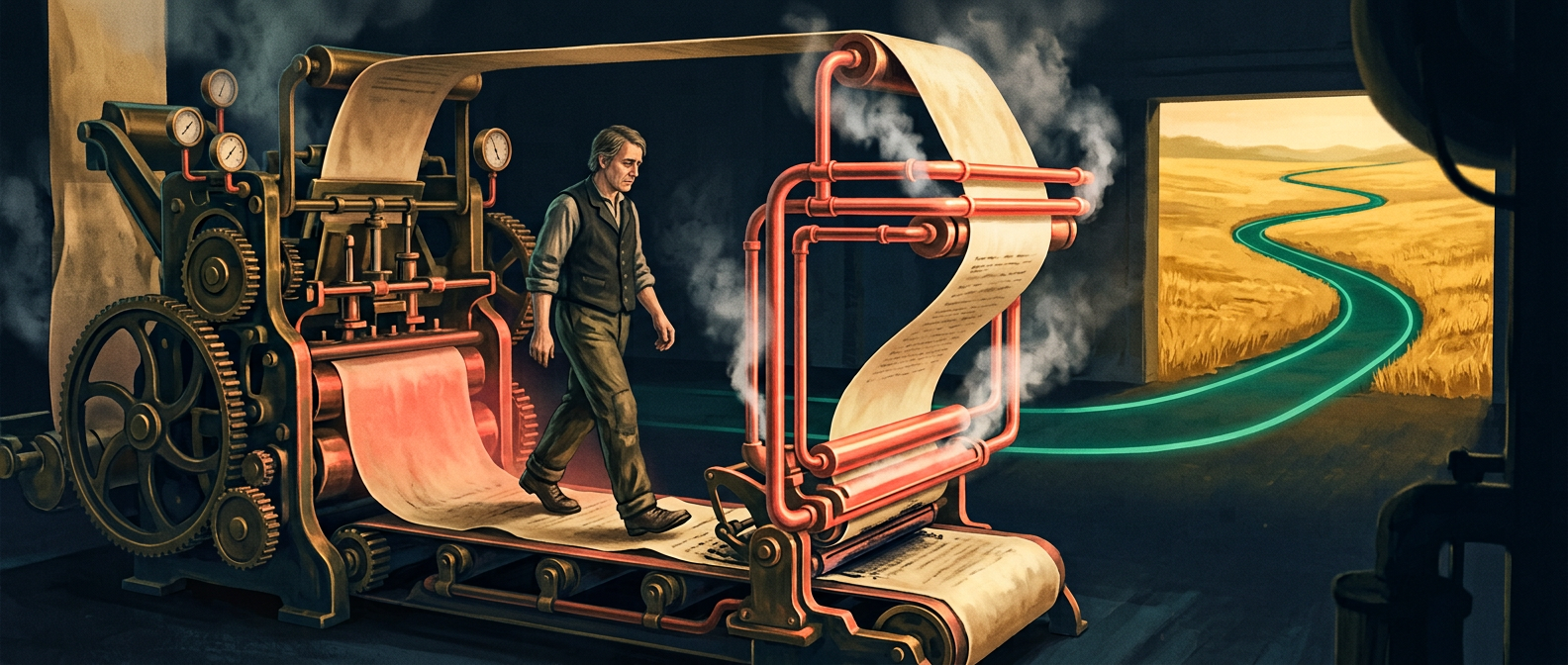
Overthinking isn’t thinking too much. It’s thinking the wrong kind of thoughts, in a loop your brain mistakes for progress.

That distinction is the whole thing. Overthinking feels productive because it produces a steady stream of thoughts that all make sense to you internally. But your brain confuses two very different things: having thoughts about a problem, and making progress on a problem. The two are not the same, and on a neurological level they light up different circuits entirely.
All the habits below share one structure. They generate mental activity that feels like work, without changing a single thing in the world outside your head.
A founder who “decided” for three weeks
A founder spends three weeks deciding whether to pivot her product. Here’s what she does:
- She builds spreadsheets.
- She lists pros and cons.
- She calls advisors.
- She writes long reflections about where she’s headed.

Three weeks pass. Nothing has changed externally — same product, same metrics, same customers. She feels exhausted, and she feels like she’s decided, but if you asked her to actually state the decision, she couldn’t. Because no decision was made. She was rehearsing. The pivot was simply thought about, again and again, and the loop felt like work so the loop continued.
The pivot finally happens six months later, when a customer does something that forces the issue. Reality made the decision her thinking never did.
What’s happening in the brain
Overthinking lives in a network of the brain called the default mode network — the system that handles self-referential thought — and specifically in a region called the posterior cingulate cortex, which is tied to rumination.
Two things make this loop so hard to escape.
First, the default mode network is expensive to run and rewarding to engage. That’s why thinking genuinely feels like labor. Your brain is burning real energy, so it concludes it must be accomplishing something.
Second, this network operates mostly disconnected from your action circuits in the basal ganglia. So the thoughts it generates rarely translate into behavior. You can think a problem to death and your hands never move.

Susan Nolen-Hoeksema spent years studying rumination and found something worse than waste: it doesn’t just fail to solve problems, it actively deepens them. Every loop strengthens the very neural pathways of the worry itself. The more you ruminate, the better your brain gets at ruminating. It’s not a plateau, it’s a slide.
The question that breaks the loop
Here’s the one move that works.
After your next thinking session, ask yourself a single question:
Did anything in the world change because of that thought?

Not your mood. Not your feeling of certainty. The world. Did a number move, a customer respond, a document get written? If the answer is no, then get up and act on the seventy percent you already understand.
You already know more than you think you do. Aap ke paas jawaab pehle se hai, bas aap usay soch ke thak rahe hain. The peace you’re looking for won’t come from one more turn around the loop — it comes from taking the step your sukoon is waiting on the other side of.

Thinking is only useful when it changes what you do next.


Comments (0)
Leave a Reply
No comments yet. Be the first to share your thoughts!