
Why You React Before You Think (and the 4-Step Brake That Beats the Amygdala)

A sharp comment lands, a boundary gets crossed, or a frustrating message appears on your screen. Before your conscious mind can evaluate the situation, your body has already made a choice: your heart rate spikes, your muscles tense, and a knee-jerk reaction is halfway out of your mouth.
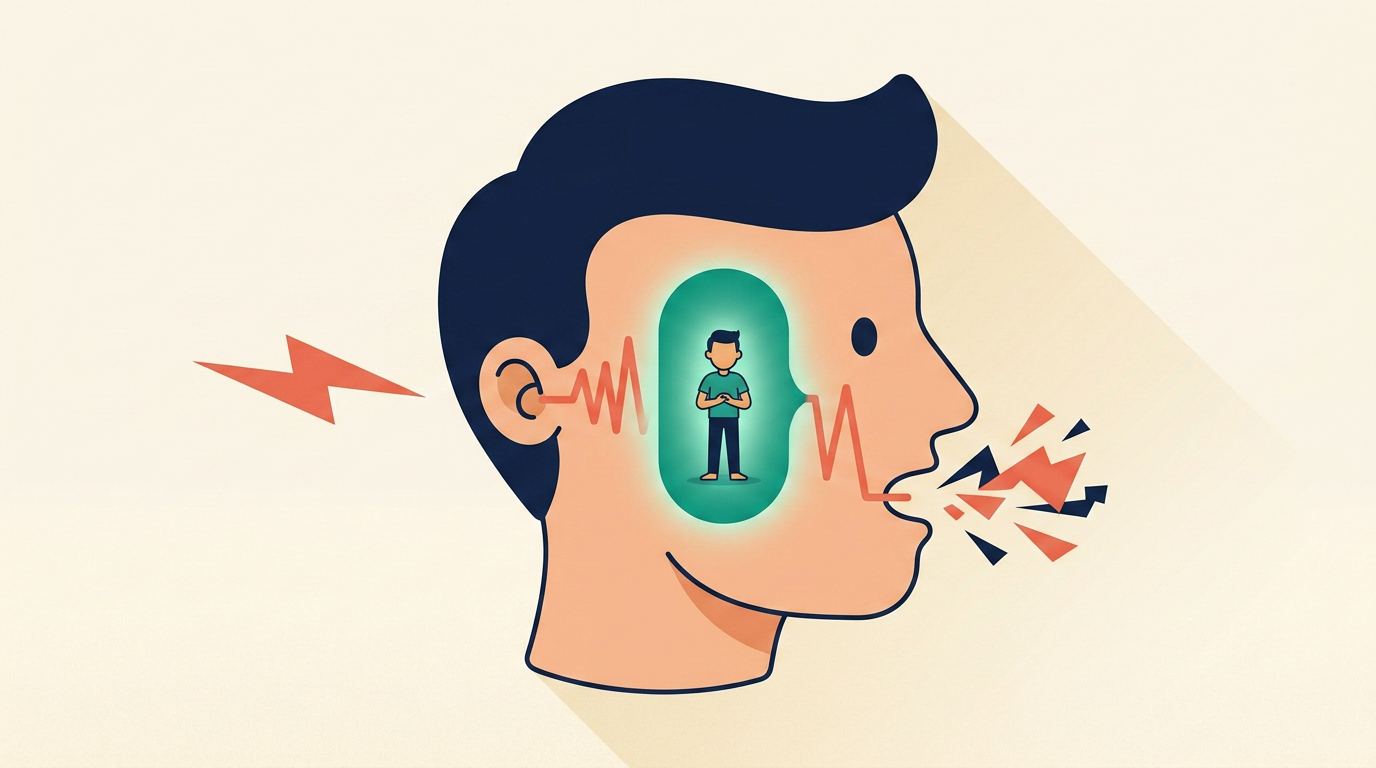
Neuroscientist Viktor Frankl famously observed that between stimulus and response, there is a space—and within that space lies our freedom to choose. The physiological challenge, however, is that this space is biologically microscopic. Without deliberate intervention, the brain’s amygdala triggers an automatic fight-or-flight response long before the analytical prefrontal cortex can intervene.

Developed by Jon Kabat-Zinn in 1979 as part of Mindfulness-Based Stress Reduction (MBSR), the STOP method is designed to widen that space. It is not a meditation technique intended to produce instant calm; it is a rapid cognitive brake engineered to interrupt automatic reactivity in the middle of a normal day.

The Four-Step Micro-Intervention
The framework operates as a precise, sequential intervention:
- S — Stop: Pause your physical and verbal impulses. You cannot alter a mental trajectory while executing the physical action driven by it.
- T — Take a breath: Focus on a prolonged exhale. A four-count exhale stimulates the vagus nerve, signaling the autonomic nervous system to down-regulate sympathetic fight-or-flight arousal and re-establish parasympathetic control.
- O — Observe: Pivot your attention inward. What does your body feel? What thought is running? In neuroscience, this relies on affect labeling. Studies by UCLA psychologist Matthew Lieberman demonstrate that naming internal states—such as “heat in the chest” or “feeling unrespected”—engages the right ventrolateral prefrontal cortex, which directly dampens amygdala hyperactivity.
- P — Proceed: Choose an intentional action aligned with your long-term goals rather than your immediate emotional surge.

Anatomy of a Paused Reaction
Consider a parent walking into a room to find her teenager violating a clear rule about screen time.

The automatic impulse—to yell, threaten, and immediately confiscate the device—is already loading. Applied in real time, the framework alters the entire trajectory:
- Stop: She sets her bag on the table and halts her vocal response.
- Take a breath: She completes a slow four-count exhale, dropping her heart rate.
- Observe: She notices physical heat in her chest, identifies the thought (“He doesn’t respect me”), and uncovers the underlying vulnerability—hurt—masked by the anger.
- Proceed: She steps forward and speaks calmly: “Put it away. We’ll discuss this in twenty minutes.”
The pause transforms a potential power struggle into a firm, constructive conversation.
Rewiring the Reflex
Research led by neuroscientist Amishi Jha demonstrates that micro-doses of deliberate mindfulness strengthen the prefrontal cortex’s inhibitory control over the amygdala—even among high-stress populations like firefighters and military personnel.

To build this neural pathway, anchor the protocol to a single recurring daily trigger: the moment before you open an email notification, answer a phone call, or step through your front door after work.

You cannot choose the trigger. You can choose the next ten seconds. That brief window is where your character is built.



Comments (0)
Leave a Reply
No comments yet. Be the first to share your thoughts!